From a frontline service provider's perspective, an in-depth analysis of the core challenge in property sewer maintenance — tree root intrusion blockage — and the practical application of two high-efficiency professional removal tools.

How to Solve Tree Root Blocked Pipes?
A Professional Sewer Cleaner's Field Guide
From a frontline service provider's perspective, an in-depth analysis of the core challenge in property sewer maintenance — tree root intrusion blockage — and the practical application of two high-efficiency professional removal tools.
After more than a decade in the sewer cleaning industry, I've seen far too many property managers helpless against recurrently blocked pipes. Slow drainage, persistent odors, sewage backup — behind these issues often lurks a culprit far more stubborn than grease or hair: tree roots.
In property maintenance, sewer blockage is one of the most common and frustrating problems. Among them, blockages caused by tree root intrusion into pipes are widely recognized by the industry as "the toughest nut to crack" due to their stealthy nature, destructive power, and high recurrence rate. Today, I will approach this from the perspective of a professional sewer service provider, systematically outlining the main types of pipe blockage issues, focusing on the causes and solutions for tree root blockage, and sharing two indispensable professional tools from my daily operations.
Sewer Cleaning: What Do We Face Every Day?
Before diving into the tree root problem, it's necessary to understand the full picture of property sewer blockages. Based on years of accumulated service data, I've categorized common blockage types into five major groups:
| Blockage Type | Common Cause | Frequency | Difficulty | Typical Scenario |
|---|---|---|---|---|
| Grease Solidification | Kitchen grease cools and solidifies in pipes, gradually adhering to pipe walls | ★★★★★ | Medium | Restaurant drains, cafeteria pipes |
| Hair & Fabric | Hair and fibers accumulate and tangle at pipe bends | ★★★★☆ | Low | Residential bathrooms, laundry rooms |
| Foreign Objects | Construction debris, hygiene products, toys and other hard objects causing obstruction | ★★★☆☆ | Medium | Toilets, floor drains, storm drains |
| Tree Root Intrusion | Tree roots grow into pipes through joints and cracks | ★★★☆☆ | Very High | Drainage pipes under landscaped areas, older properties |
| Pipe Collapse | Pipe aging, breakage, or ground settlement causing pipe deformation | ★★☆☆☆ | Very High (requires excavation) | Aging municipal networks, heavy vehicle zones |
As we can see, while grease and hair blockages occur most frequently, they are relatively simple to handle — high-pressure water jetting or mechanical snaking can resolve them. Tree root intrusion, however, doesn't have the highest frequency but is rated "Very High" in difficulty — this is exactly the core issue this article focuses on.
In older neighborhoods and properties with high landscaping coverage, tree root blockages account for over 30% of all severe blockage cases. More critically, without the correct tools and methods, the recurrence rate of tree root blockages reaches 70%-80%, with many properties needing to repeatedly clear the same pipe section year after year.
Tree Root Blockage: The "Silent Killer" of Property Pipes
Why Do Tree Roots "Get Into" Pipes?
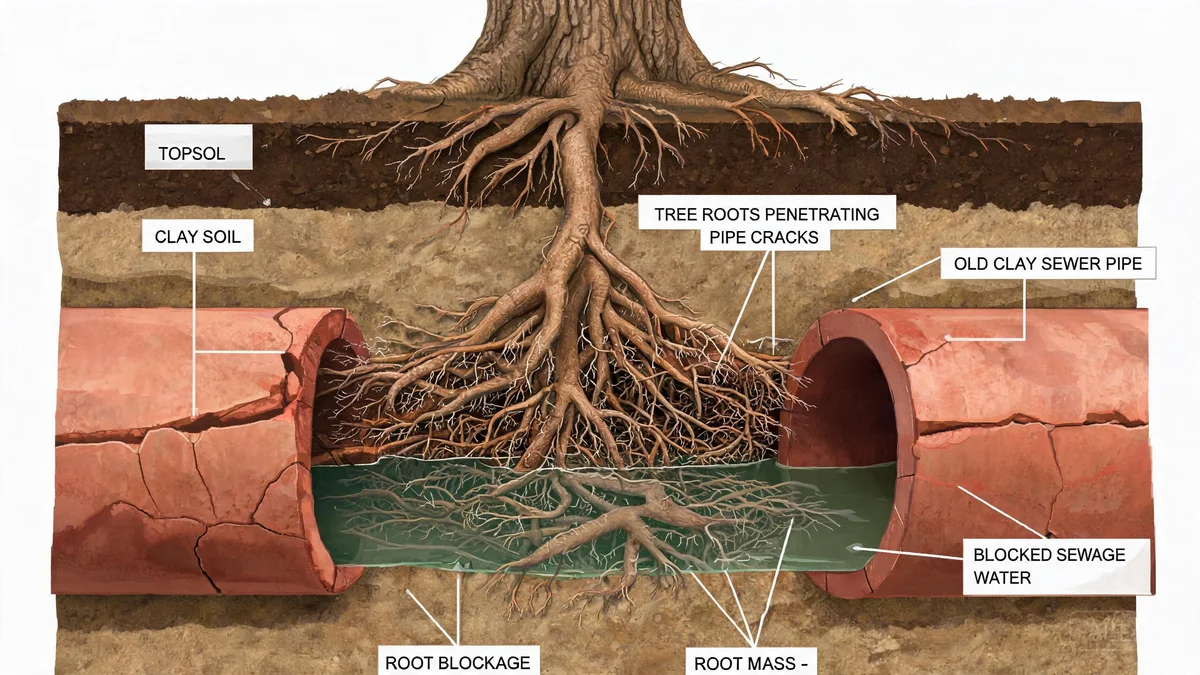
Many people don't understand how tree roots can penetrate sturdy pipes. In reality, tree roots don't "penetrate" the pipe walls — they exploit natural weak points in the piping system:
1. Pipe Joints
Whether it's old-style bell-and-spigot clay pipes, concrete pipes, or newer PVC pipes, there are gaps at the connections between each pipe segment. These gaps may be tiny, but they're sufficient for the fine tips of tree roots. The roots' hydrotropism (water-seeking growth) and chemotropism (nutrient-seeking growth) drive them to follow moisture and organic matter seeping from the pipes, gradually growing inward.
2. Pipe Wall Cracks
When pipes develop cracks due to ground settlement, traffic vibration, or material aging, tree roots quickly invade along these cracks. This is especially accelerated during rainy seasons when pressure differentials between the pipe interior and exterior change.
3. Manhole Connections
If the seals at the connection between inspection manholes and pipes age and fail, they also become entry points for tree roots. This type of invasion typically starts near the manhole and extends outward in both directions.
The Progression of Tree Root Blockage
Tree root blockage doesn't form overnight — it follows a gradual progression from "dormant" to "eruptive":
- Intrusion Phase (1-2 years) Fine roots enter the pipe through gaps. In the early stages, the impact on drainage is minimal with almost no symptoms. A small number of fibrous roots may be visible on the pipe interior walls.
- Growth Phase (2-5 years) After obtaining ample water and nutrients inside the pipe, the roots accelerate growth and gradually form a web-like structure. Symptoms such as slow drainage and occasional blockages begin to appear, which can be temporarily relieved by conventional clearing.
- Severe Blockage Phase (5+ years) The roots have formed dense masses that severely impede or completely block water flow. Conventional clearing methods are no longer effective. Sewage backup and persistent odors become the norm.
- Pipe Destruction Phase Thick roots continue to expand, widening cracks and even causing pipe fracture and misalignment. This may ultimately require excavation and pipe replacement, causing maintenance costs to skyrocket.
The most dangerous aspect of tree root blockage is its stealthiness. By the time property managers notice noticeable drainage abnormalities, tree roots have often been growing inside the pipes for 3-5 years. CCTV pipe inspection is the only reliable method for early detection. For properties with high landscaping coverage, it's recommended to conduct pipe interior inspections every 2 years.
Why Can't Traditional Clearing Methods Handle Tree Roots?
Faced with tree root blockages, many properties first try traditional clearing methods. But field experience tells us these approaches often treat symptoms without addressing the root cause:
| Traditional Method | How It Works | Effect on Tree Roots | Limitations |
|---|---|---|---|
| Chemical Agents | Pouring copper sulfate, herbicides, or other chemicals | Only kills fine fibrous roots | Cannot remove established thick root masses; environmental pollution; pipe corrosion |
| Manual Drain Snake | Rotating spring steel cable for clearing | Can "drill" a channel through root masses | Only opens a channel; roots remain; fibrous roots regrow within days; cannot cut thick roots |
| Standard Pressure Washer | Front-jet spray nozzle flushing | Can flush away some debris and fine roots | No cutting capability; ineffective against woody thick roots; cannot remove root bases |
| Excavation & Replacement | Digging up ground, cutting and replacing pipes | Complete solution | Extremely high cost; disrupts pavement and landscaping; long construction time; not all sites allow excavation |
Clearly, traditional methods are either not powerful enough or too costly. What we need is a professional solution that falls between "manual snaking" and "excavation replacement" — one that can powerfully cut and remove tree roots without destroying the ground surface. This is where high-pressure water jetting combined with specialized cutting nozzles technology truly shines.
High-Pressure Water Jetting + Mechanical Cutting: The Professional's Weapon
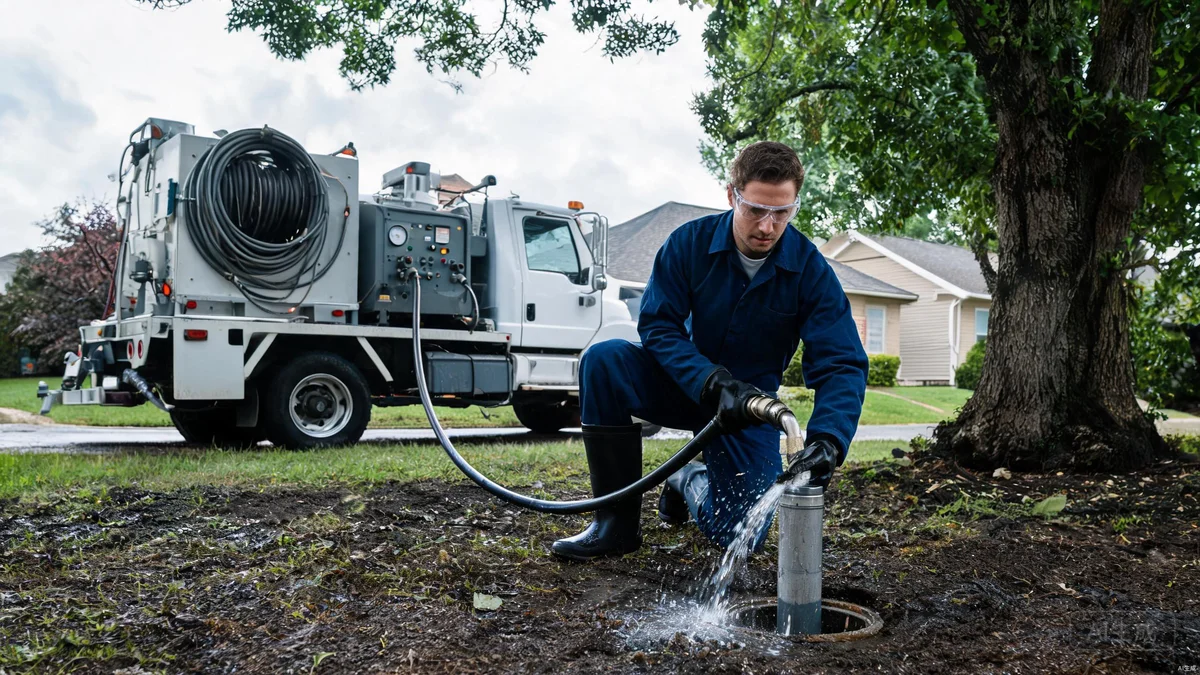
The core technology of modern professional tree root clearing is mechanical cutting driven by high-pressure water jetting. The principle: a high-pressure pump generates a large volume of high-pressure water flow that drives specially designed rotating nozzles, which in turn spin mechanical cutting components at high speed, creating a powerful combined cutting and flushing action inside the pipe.
This technology offers three fundamental advantages over traditional methods:
1. Cutting, Not "Drilling Through"
Professional cutting nozzles are equipped with chain flail arms or blades that can physically sever thick tree roots rather than just squeezing a channel through the root mass like a drain snake. The cut root fragments are then flushed away by the high-pressure water flow, restoring the pipe to its original diameter.
2. Root Base Removal
High-pressure water jets not only flush away cut debris but also scour the pipe walls, removing residual root material and biofilm adhered to the walls, dramatically reducing recurrence rates.
3. Non-Destructive Operation
The entire process requires no excavation — work is performed through existing inspection manholes or cleanout access points. Flexible high-pressure hoses can navigate pipe bends and diameter changes without causing mechanical damage to the pipes themselves.
However, the effectiveness of this technology depends heavily on tool selection. Different pipe sizes, blockage severity, and root types require matching different specialized cutting nozzles. Next, I'll detail two of the most frequently used professional tools in daily operations.
0.5k Root Cutter Nozzle: Flexible Chain Flail, Precision Root Shredding

How It Works
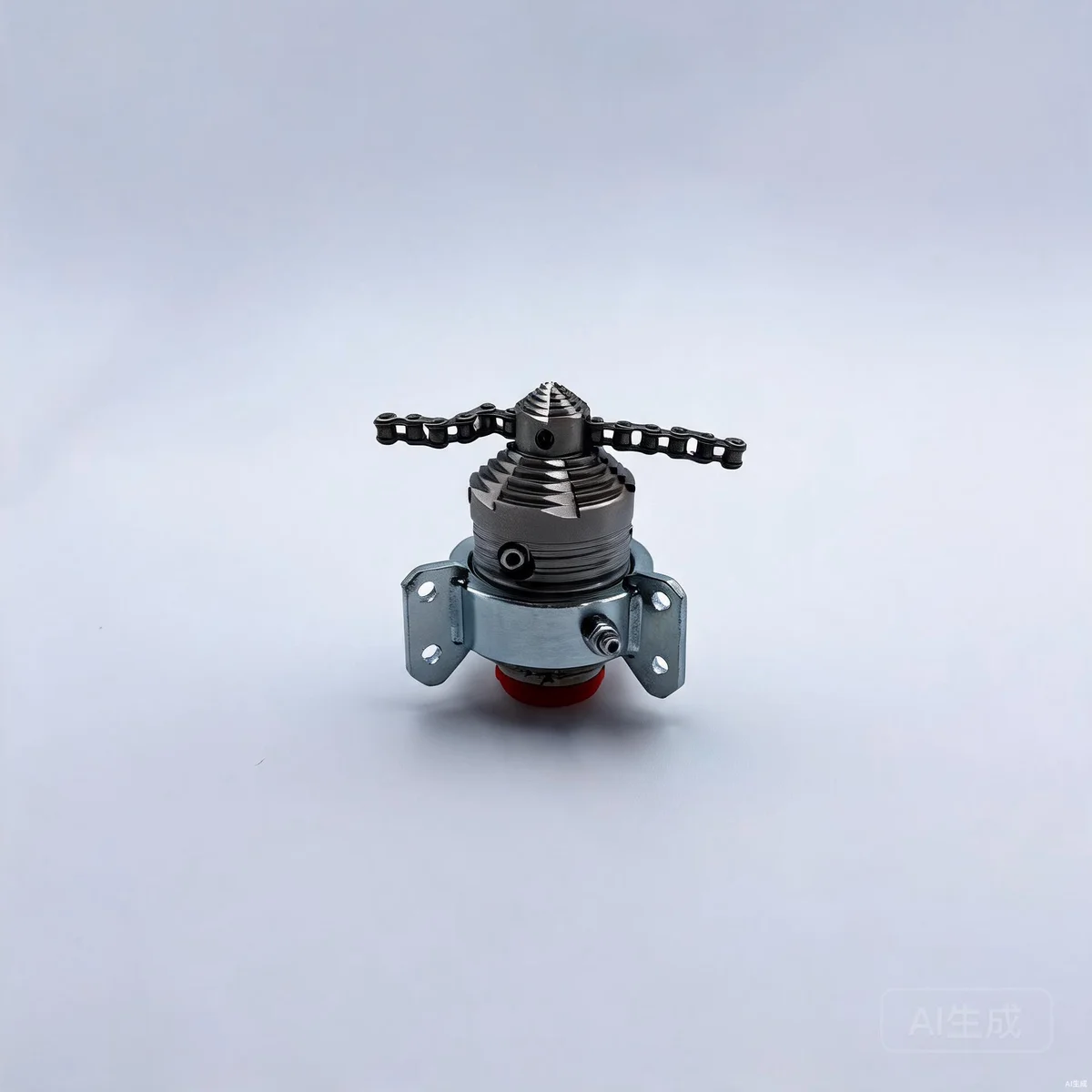
The 0.5k root cutter nozzle employs the chain flail cutting principle. When high-pressure water enters the nozzle's internal turbine chamber, it drives the central shaft to rotate at high speed through tangential nozzles. Two industrial-grade roller chains, symmetrically mounted on either side of the central shaft, are thrown outward by centrifugal force to full extension, forming two high-speed rotating "flails" that whip and cut tree roots inside the pipe at extremely high tip velocities.
The spiral-grooved pointed tip at the top of the nozzle allows it to initially pierce through root masses during advancement, creating working space for subsequent chain cutting. The nozzle is equipped with 3 side jets (M6) and 6 rear jets (M6); the rear jets provide propulsion and flushing force, washing cut root debris out of the pipe.
Core Design Advantages
| Design Feature | Engineering Value |
|---|---|
| Dual-Chain Symmetric Layout | Excellent rotational dynamic balance, low vibration, protects pipe interior walls from eccentric impact damage |
| Flexible Chain Arms | Conforms to pipe bends, diameter changes, and minor deformations; strong passability; resistant to jamming |
| Stepped Turbine Chamber | Multi-stage flow guide design improves hydraulic energy conversion efficiency; achieves high RPM at lower pressure |
| Hex Socket Set Screw | Allows field adjustment of preload force to control activation pressure threshold for different operating conditions |
| Replaceable Seal Ring | Bottom seal can be individually replaced when worn, reducing long-term maintenance costs |
Technical Specifications
| Parameter | Specification |
|---|---|
| Part # | 0.5K-DSGTZ |
| Name | 0.5 Root Cutting Kit |
| Material | Hardened Stainless Steel |
| Forward Jet | — |
| Side Jet | 3 × M6 |
| Rear Jet | 6 × M6 |
| Thread | 1/2" F |
| Flow | Customized (Test: 50 LPM) |
| Pressure | Customized (Max: 350 bar) |
| Dimension | Φ36 × 68 mm |
Application Scenarios
When using the 0.5k nozzle, it's recommended to first use CCTV inspection to confirm the location and severity of the root blockage. For dense root masses, use incremental sectional cutting: advance the nozzle to the edge of the root mass, gradually increase pressure, advance 10-20cm at a time, and make repeated back-and-forth cutting passes until fully penetrating. After cutting is complete, switch to a standard flushing nozzle for wall cleaning.
4"/6" Pipe Cutter & Accessory System: Hard Blades, Precision Cutting
Product Overview
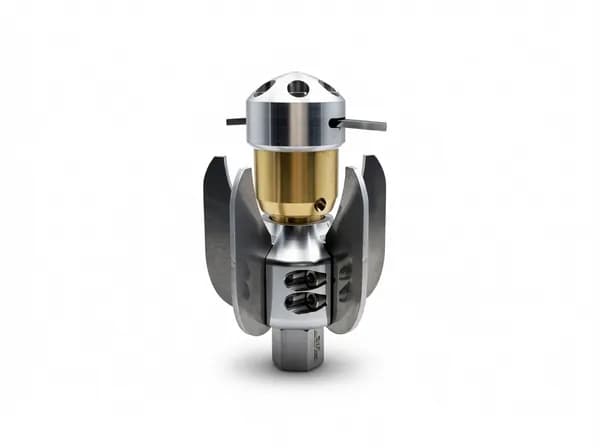
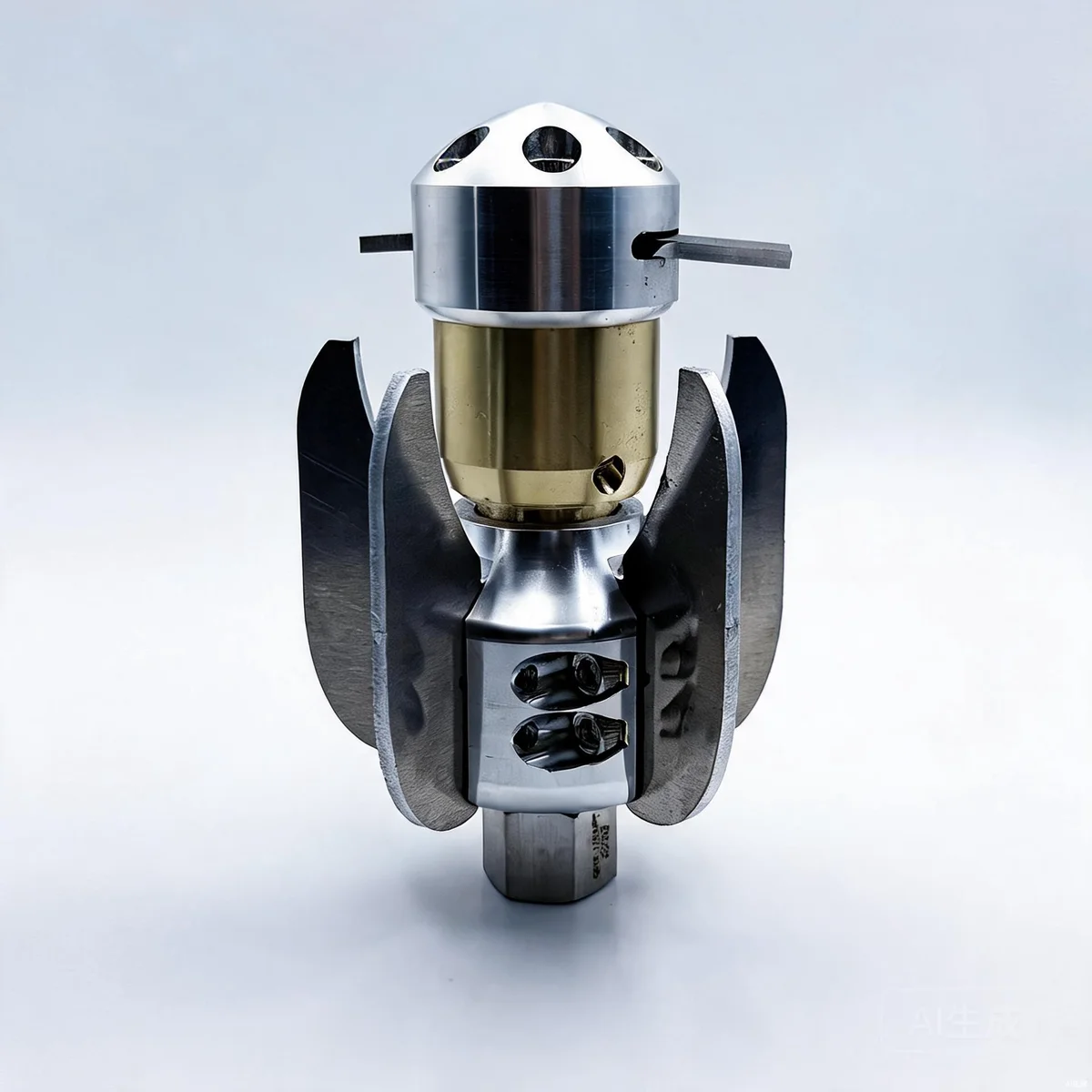
The 4"/6" pipe cutter is a hard-blade rotary cutting tool. Unlike the 0.5k chain nozzle's flexible flailing action, it uses four high-hardness curved blades arranged in a cross pattern to form a complete circular cutting profile. The golden transition sleeve provides bearing functionality, the silver dome top features a drive pin interface, and the bottom hex shank fits standard power tools.
How It Works
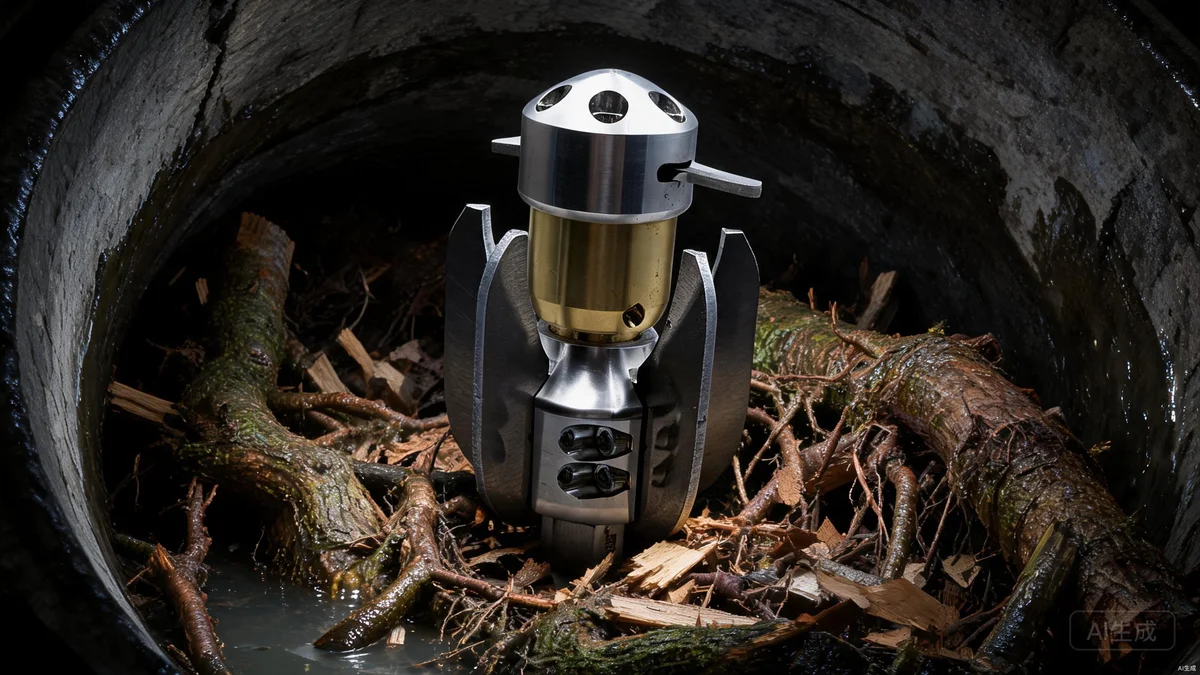
The cutter is driven to rotate by high-pressure water flow or an external power head. The four crescent-shaped blades cut through tree roots and obstacles inside the pipe in a milling action during rotation. Compared to the chain-flail nozzle, the hard blades provide more precise cutting control and stronger cutting force, making it particularly suited for handling highly lignified, thick-diameter stubborn root masses.
Core Design Advantages
| Design Feature | Engineering Value |
|---|---|
| Four-Blade Cross Layout | Even cutting force distribution, high circularity, excellent dynamic balance performance |
| Transition Sleeve | Withstands axial reaction force, reduces friction, extends bearing life |
| Modular Blade System | Blades are replaceable; switching blade sets covers 4"-6" pipe diameter range |
| Top Drive Pin Interface | Compatible with standard high-pressure rotary nozzle drive components; quick assembly/disassembly |
| Hex Drive Shank | Standard power tool interface; can also be used for manual preloading or emergency operation |
DN100/DN150 Accessory System
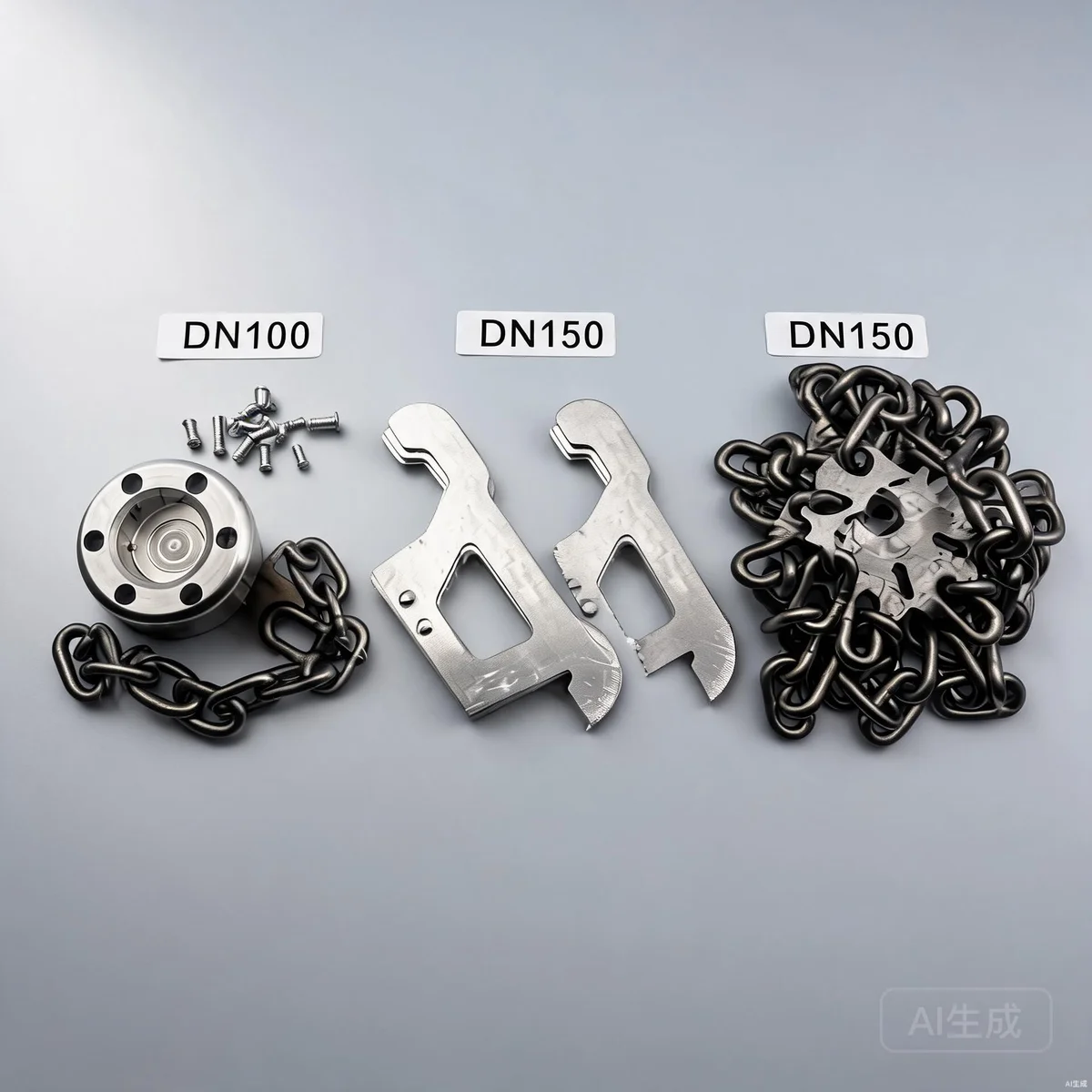
The cutter is equipped with a complete DN100 (4") and DN150 (6") replacement accessory system, ensuring optimal cutting performance across different pipe diameters and operating conditions:
| Accessory Type | Spec | Function Description |
|---|---|---|
| Hook-Shaped Cutting Blade | DN150 | Primary cutting component; curved edge cuts into pipe wall deposits |
| Chain Assembly | DN100/DN150 | Wraps around pipe to form a clamp; secures cutter position and transmits rotational force |
| Flange Plate / Tensioner Seat | DN100 | Chain tensioning and guide mechanism; 6-hole flange connects to main body |
| Star Sprocket / Indexing Disc | DN150 | Feed adjustment mechanism; multi-tooth design enables graduated cutting depth control |
| Fastener Set | Universal | Pins, bolts, washers for quick assembly/disassembly and position locking |
Technical Specifications
| Parameter | Specification |
|---|---|
| Part # | QGQ |
| Name | 4/6 Inch Cutter |
| Material | Hardened Stainless Steel |
| Forward Jet | — |
| Side Jet | — |
| Rear Jet | 3 × M5 |
| Thread | 3/8" F |
| Flow | Customized (Test: 50 LPM) |
| Pressure | Customized (Max: 350 bar) |
| Dimension | Φ56 × 125 mm |
Application Scenarios
In actual operations, the 0.5k chain nozzle and the 4"/6" cutter are often used in combination. First, use the 0.5k chain nozzle for large-area flexible cutting to quickly clear the majority of roots inside the pipe; then switch to the 4"/6" cutter for precision cutting to handle remaining thick root nodes and wall deposits. This "flexible first, rigid second" combined strategy ensures both efficiency and thoroughness of removal.
Standard Professional Root Clearing Workflow
Having the right tools requires the right methods. Below is the standard tree root clearing workflow I've summarized from years of field experience:
- CCTV Pipe Inspection & Diagnosis Use a pipe inspection camera to thoroughly examine the blocked pipe section, confirming the location, extent, and severity of root intrusion, as well as the pipe's own condition (any collapse or misalignment). This step is critical — it determines subsequent tool selection and the construction plan.
- Tool Selection & Preparation Select tools based on inspection results: for pipes DN150 and above with primarily fibrous and fine roots, the 0.5k chain nozzle is the first choice; for 4"-6" pipes with thick lignified root masses, use the 4"/6" cutter; for complex conditions, use both in combination. Verify that high-pressure pump pressure and flow rate match, and that hose connections are reliable.
- Pre-Flushing & Positioning First use a standard flushing nozzle to pre-clean the blocked section, clearing surface sludge and debris to create working space for the cutting tool. Use a distance counter to record pipe distance and precisely position the cutting tool's front end.
- Incremental Sectional Cutting Advance the cutting tool to the edge of the root mass, starting at low pressure and gradually increasing. Advance 10-20cm at a time, making 2-3 back-and-forth cutting passes within the root mass to ensure thorough shredding. Never force-advance in one push — this can cause tool jamming or pipe damage.
- Flushing & Debris Removal After cutting is complete, immediately use a high-flow flushing nozzle to wash shredded root debris out of the pipe. Flush repeatedly 2-3 times until the discharge water runs clear.
- Re-Inspection & Acceptance Conduct another CCTV inspection to confirm that all roots have been cleared from the pipe, walls are smooth again, and no residual roots remain. Record before-and-after comparison footage as construction acceptance documentation.
- Preventive Treatment For pipe sections with severe root intrusion, apply chemical root control treatment after clearing — coat or inject slow-release root growth inhibitors onto pipe walls to delay re-intrusion. Also recommend preventive clearing maintenance every 12-18 months.
The recurrence rate of tree root blockage is the top concern for property managers. Based on my experience, using professional cutting tools with a standard workflow can extend the recurrence cycle from the traditional 3-6 months to 18-24 months. The key is: cut thoroughly (leave no residual roots), flush completely (leave no debris), and prevent properly (regular inspection + root control treatment).
Tree Root Blockage? Professional Tools Are the Key
Whether you're a property manager, municipal maintenance unit, or professional clearing service provider, choosing the right professional tools is the first step to efficiently solving tree root blockage. The 0.5k chain-flail root cutting nozzle and the 4"/6" cutter accessory system are indispensable tools in your pipe maintenance arsenal.
Learn More About Our ProductsHorizon Integrity
Industrial Cleaning Equipment Specialist · Horizon Integrity